
 (510) 609-1215


On May 22, 2025, RecycleMore hosted the West Contra Costa Integrated Waste Management Authority (WCCIWMA)/RecycleMore Board of Directors and member city agencies staff to a Republic Services’ facility tour. The tour used a chartered bus from FirstStudent and went to the West County Integrated Resource Recovery Facility (IRRF), the West Contra Costa Household Hazardous (HHW) Waste Facility located at 101 Pittsburg Ave, Richmond, California, and then continued to the Golden Bear Transfer Station, Construction and Demolition Facility and Compost Facility located at 1 Parr Blvd, Richmond, California. The Republic Services staff (Ken Lewis, Peter Nuti, Frank Canelo and Alex Shimada) led the guided tour which allowed a firsthand look at the facilities where West Contra Costa waste, recycling, organics, and hazardous waste materials are sorted and processed.
Household Hazardous Waste Facility
The first stop was the Household Hazardous Waste (HHW) Facility. This is a drop off center to dispose of your no longer needed HHW items, safely. Residents are allowed to drive through this part of the Facility where they are greeted by staff. Upon showing identification, staff will remove the hazardous waste items from your vehicle and place them in the designated sorting area of the facility, where they are eventually transported to be recycled or safely disposed of.
To learn more about hazardous waste, what is acceptable, facility information, including commercial hazardous waste programs, access the RecycleMore Hazardous Waste website page.
West County Integrated Resource Recovery Facility (IRRF) Recycling Facility
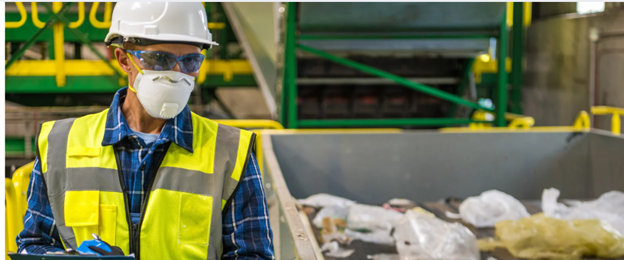
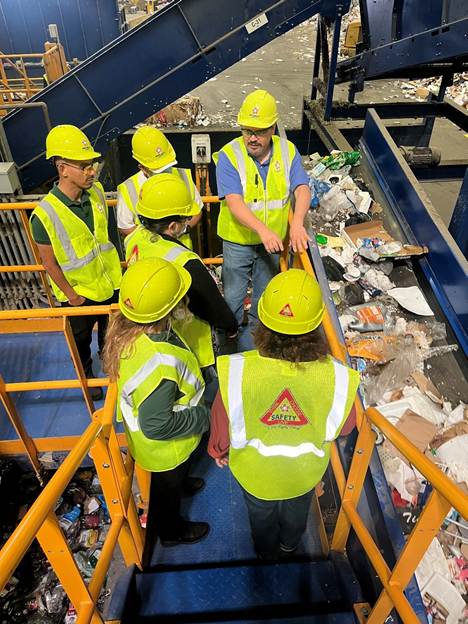
The next stop was the recycling facility. This facility is loud with a lot of moving parts. Tour participants were instructed to stay in the designated walkways and wear the provided protective gear including a hard hat, safety glasses, and a bright yellow vest to keep everyone safe amidst the working machinery, equipment, and trucks that are important components of the working facility.
This part of the tour showcased the large state-of-the-art sorting machines that automate the sorting process of the items collected at your curbside.
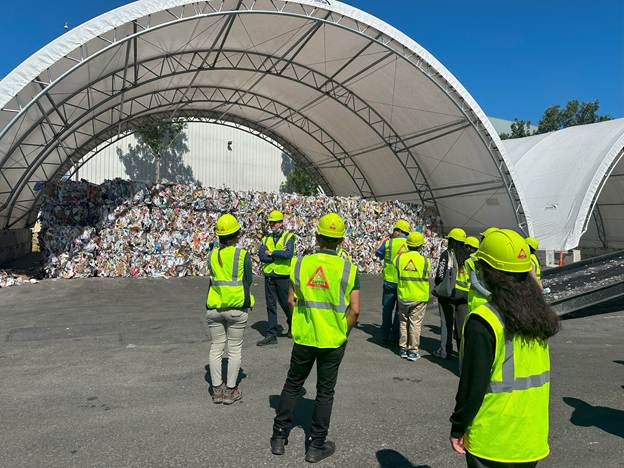
Walking outside and around the back of the facility, tour participants observed the many types of colored glass that gets recovered. The tour then continued to the area where the bales of plastic, paper, cardboard, and aluminum cans were stacked neatly and tightly bundled, ready to be loaded onto a truck to be transported to other facilities where they are made to create new products.
Unsure on what items are accepted for recycling? Learn what types of materials you can place in the blue recycled bin to be collected at your curbside by accessing the online RE:Source “What Goes Where” tool.

Transfer Station
Tour participants loaded onto the bus and were driven to the Golden Bear Transfer Station to observe where the garbage trucks empty their loads, and where residents and businesses can self-haul their waste. This facility consolidates the waste and loads it into transfer trucks to drive to the Keller Canyon Landfill in Pittsburg, California, for disposal.
Construction and Demolition Facility
The tour bus then drove by the construction and demolition facility, referred to as the C&D facility, and observed where construction materials get directed for drop off by self-haulers and debris boxes in order to recover untreated wood, metal, sheetrock, dirt and other materials.
Composting Facility
The tour continued to the composting facility, where Republic Services answered the question: “What happens to your organics waste that gets collected at curbside?” Republic Services receives the collected waste (approximately 350-400 tons of materials) at their 300-acre composting facility and processes it to make compost.
Once the material is screened to remove contaminants, it goes through a grinder to be reduced in size. After grinding, the material is transferred to a covered aerated static pile (CASP) system, where the material is covered, water is added and rich oxygen supplied air is injected to facilitate decomposition. No churning is necessary. The temperatures of the piles rise above 131 degrees Fahrenheit to kill off any pathogens. At any given time, there are about 25-30 piles of decomposing material. In about 4 weeks, from start to finish, the composting piles are ready. Once the compost is ready, the finished compost is screened again to remove any remaining large pieces, and then sold to landscapers, golf courses, farmers, as well as to brands that sell at home improvement stores. Composting helps jurisdictions to achieve compliance with the California Senate Bill (SB) 1383 which aims to reduce organics waste disposal to the landfill by 75%.
In addition, the finished compost is available to residents. As a resident of West Contra Costa County, you can come to the IRRF at 101 Pittsburg Ave, Richmond, California, on the first Wednesday of each month to self-haul compost made from these collected food scraps and yard trimmings for free. To learn more about this Compost Giveaway Program, access the Compost Giveaway website page.
You may have heard about gases released from composting. The decomposition of organic materials releases various gases as part of the natural breakdown process. Methane is one of these types of gases and can be produced in anaerobic (oxygen-limited) conditions. If composting is not managed properly (e.g., not enough aeration), methane can be released, contributing to greenhouse gas emissions and global warming, Methane can be more potent than carbon dioxide (CO2). The compost facility monitors the piles closely to ensure that they do not become anaerobic.
One amazing thing that was noticed during the compost facility tour was that there was no odor emitting from the piles or the area!
Want to make your own compost? Look for additional resources on backyard composting and purchase discounted compost and bins through the RecycleMore website.


Compilation Video of the Recycling Facility Tour – May 22, 2025:
At this time, there are no regular public tours available for these facilities.

Thank you!
#####